
Calcium Isotope Testing for Bone Health
A dynamic blood and urine biomarker of bone health, with potential applications in earlier identification of bone loss and monitoring of osteoporosis treatment.
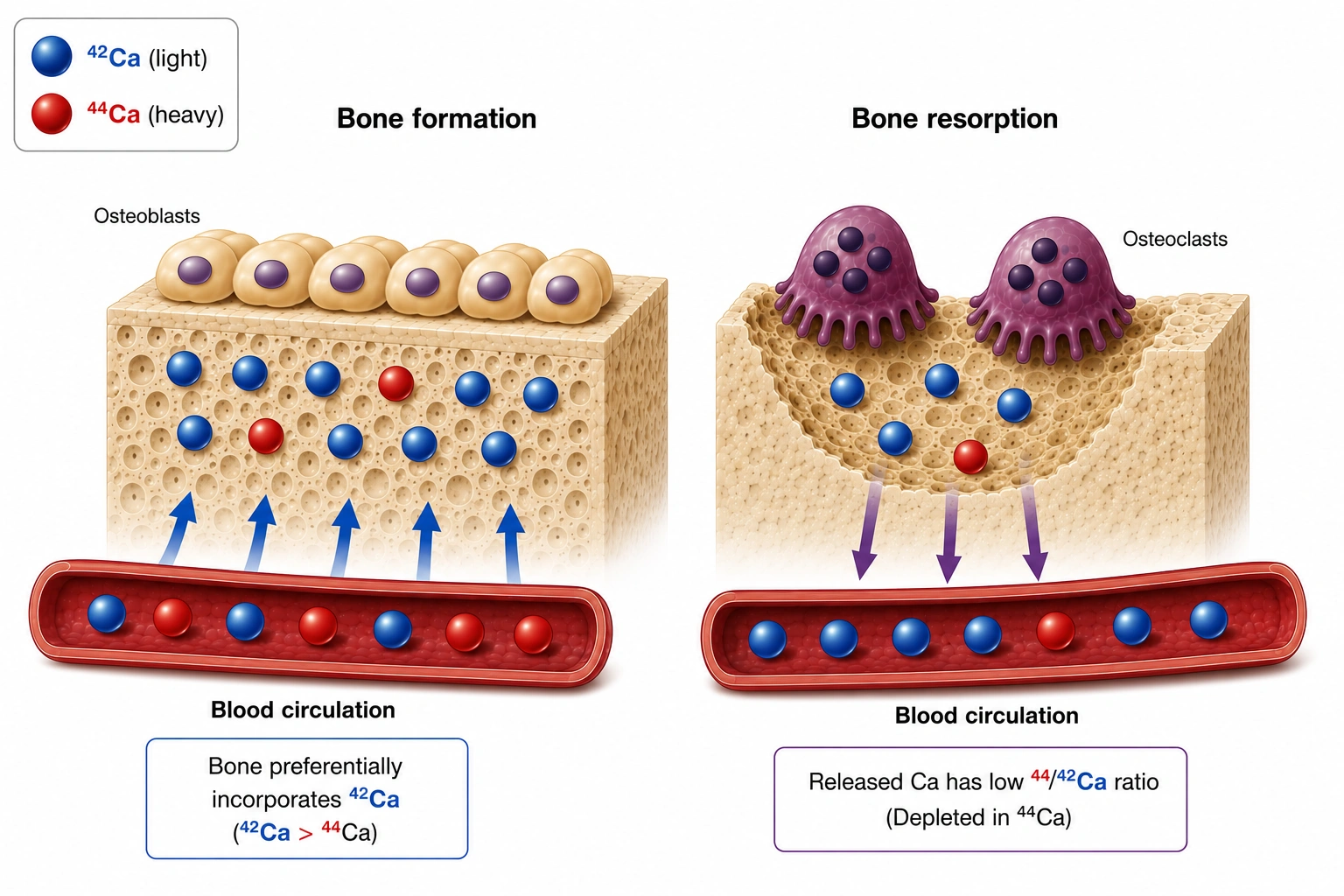
Looking beyond accumulated bone loss
Bones are constantly changing. Throughout life, old bone is broken down and new bone is formed.
When bone resorption exceeds bone formation, calcium is progressively lost from the skeleton.
DXA is essential for assessing bone mineral density, but it primarily reflects structural changes that have accumulated over time.
Calcium isotope testing is being investigated as a complementary way to measure the current balance between calcium entering and leaving the skeleton.
By measuring naturally occurring variations in calcium isotopes in blood or urine, researchers can investigate net whole-body bone calcium balance.
Potential clinical applications of calcium isotope testing
Calcium isotope testing provides a dynamic measure of net whole-body bone calcium balance. Two important clinical applications are earlier identification of bone loss and monitoring response to osteoporosis treatment.
Earlier identification of bone loss
Calcium isotope testing can identify patterns of active bone calcium loss before substantial changes in bone density have accumulated.
A simple urine test could help identify people who may benefit from earlier DXA assessment or closer follow-up.
Monitoring osteoporosis treatment
Calcium isotope values can respond within weeks of osteoporosis treatment, providing an early measure of changes in net bone calcium balance.
Serial testing may help identify differences in treatment response between individuals and support earlier clinical review where the response is not as expected.
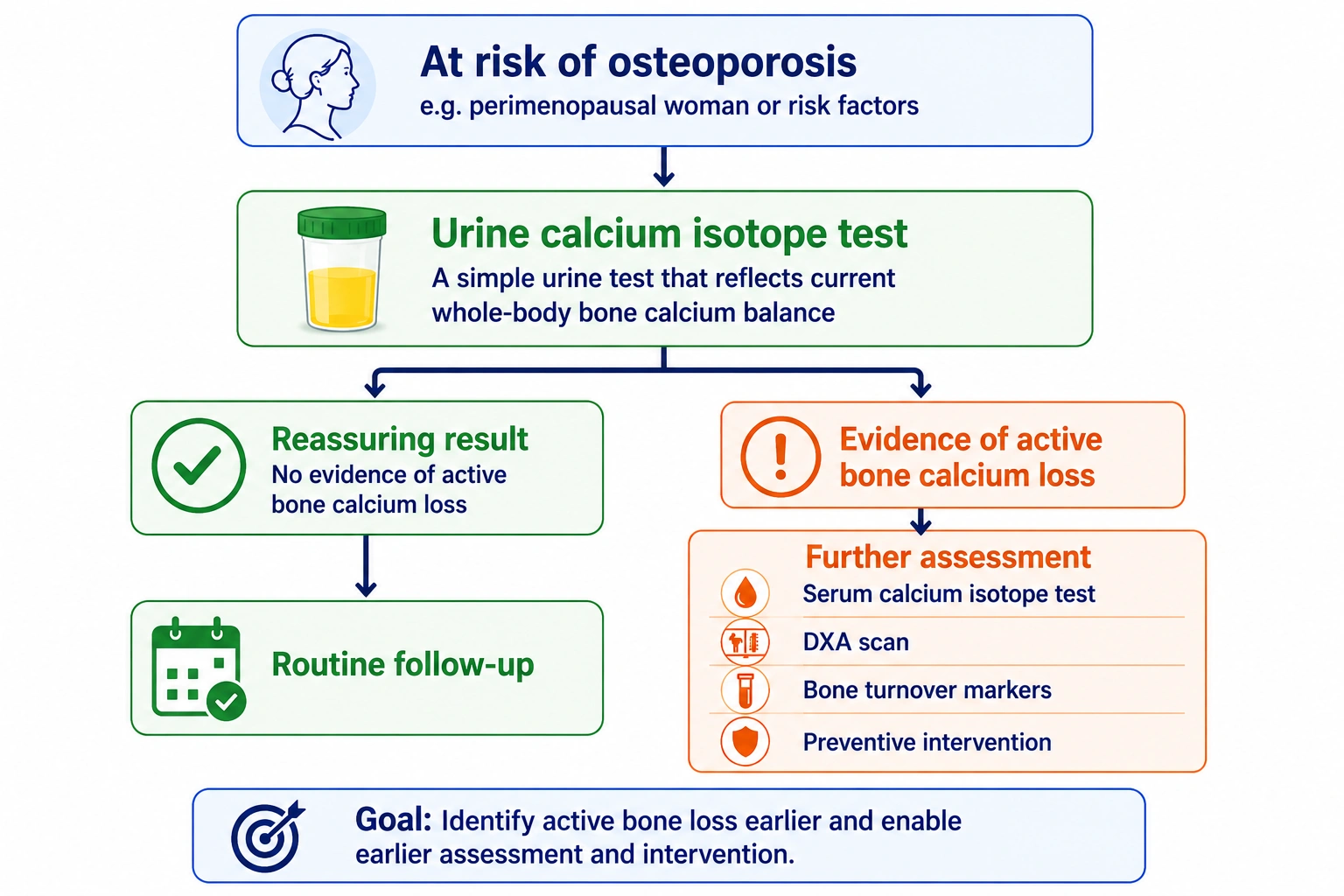
A potential pathway for earlier bone health assessment
A simple urine calcium isotope test could provide a first-line assessment of current bone calcium balance in people at risk of osteoporosis.
1. Identify people who may benefit from bone health assessment This could include peri- and early post-menopausal women or people with recognised risk factors for osteoporosis.
2. Collect a urine sample Calcium isotopes are measured to assess the pattern of net bone calcium balance. No isotope tracer or radiation is used.
3. Identify possible active bone calcium loss A result consistent with possible net bone calcium loss could prompt further clinical assessment.
4. Further assessment where indicated This could include serum calcium isotope testing, DXA, conventional bone turnover markers and other clinical investigations.
The aim is to complement DXA by identifying people who may benefit from earlier imaging, further investigation or closer follow-up.
Clinical evidence
Calcium isotope biomarkers have been evaluated in clinical and research studies of bone calcium balance, osteoporosis and treatment response.
Calcium isotope testing is commercially available in Europe. Our focus is translating and implementing this capability within Australian healthcare pathways.
Osteoporosis and early detection
A 2019 study of postmenopausal women demonstrated significantly lower serum and urine calcium isotope ratios in participants with osteoporosis.
Relative to DXA, serum calcium isotopes showed 100% sensitivity and urine calcium isotopes showed 79% sensitivity and 71% specificity in the study cohort.
Evidence from clinical practice
A 2024 post-market follow-up study evaluated calcium isotope measurements in 2,320 participants across a broad clinical population.
The study demonstrated systematic calcium isotope responses across diseases, therapies and nutritional factors affecting bone mineral balance.
Monitoring treatment response
A 2025 study showed that calcium isotope values changed within weeks of denosumab treatment and revealed substantial differences in response between individual patients.
These findings support the use of serial calcium isotope measurements to investigate treatment response.
In the media
Radio interview: Calcium isotopes and bone health
Prof. Anthony Dosseto discusses how calcium isotopes could provide a new way to assess changes in bone calcium balance in this ABC Radio Illawarra interview.
Interested in calcium isotope testing?
We are working with GPs, specialists and clinical researchers to support the adoption and evaluation of calcium isotope testing in Australian practice.
We also welcome expressions of interest from people interested in accessing the test or participating in our clinical evaluation.
Calcium isotope testing in Australia
Calcium isotope testing for bone health in Australia is being developed and implemented through the Wollongong Isotope Geochronology Laboratory (WIGL) at the University of Wollongong, led by Professor Anthony Dosseto.
WIGL has established the high-precision analytical capability required to measure calcium isotopes in blood and urine. Isochem Solutions Pty Ltd supports external engagement, testing coordination and translation into clinical practice.
We are working with GPs, endocrinologists, bone health specialists and clinical researchers to support the adoption and implementation of calcium isotope testing in Australian healthcare.
Professor Anthony Dosseto
Wollongong Isotope Geochronology Laboratory
University of Wollongong
Isochem Solutions Pty Ltd
Testing coordination and external engagement anthony@isochemsolutions.com.au
Calcium isotope testing provides a measure of bone calcium balance and is intended to complement clinical assessment and established bone health investigations, including DXA.